
How DNA supercoiling inspired a breakthrough in vibration isolation.
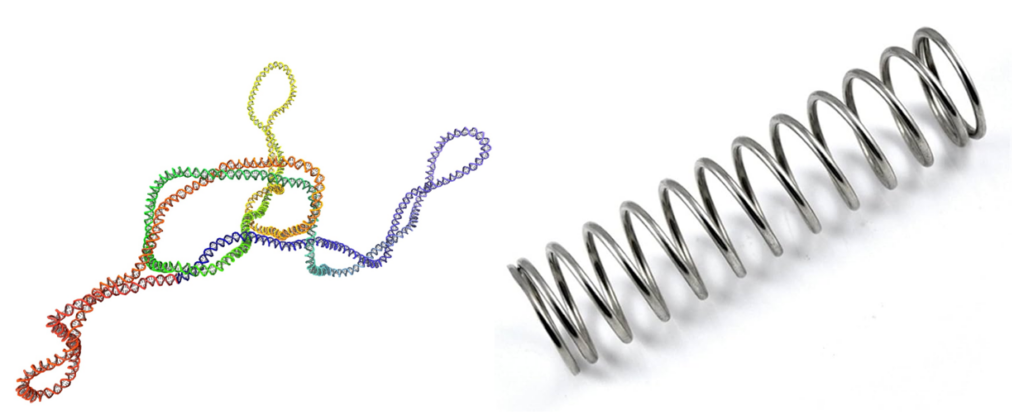
Every vibration isolator forces the same choice: Want to damp low-frequency motion? Use a soft spring. Want to carry a heavy load? Use a stiff one. You cannot have both, because the stiffness that supports weight also transmits vibration. Engineers have worked around this tradeoff with active control, bulky multi-stage mounts, and clever compromises, but the underlying physics of a conventional spring never bent.
A team led by Xin Fang reported a way around it in Advanced Materials in early 2026. Their all-steel “supercoiled” metamaterial holds an ultralow resonance frequency at or below 2 Hz while carrying loads 100 to 1,000 times higher than other isolators that reach the same frequency. It does this with geometry, not exotic alloys.
Directly Inspired by DNA
DNA stores meters of strand inside a single cell by coiling the double helix upon itself, a state biologists call supercoiling. Fang’s team borrowed the idea directly. Their structure is built from metal helices that coil at two scales at once. Under compression, the helix twists as it buckles. That global twist is what raises strength and stores energy, while the gentle local curvature keeps stress spread out along the metal instead of piling up at one point.
That second part is why it survives. A straight strut concentrates stress where it bends and eventually cracks. A curved, twisting helix distributes the same load along its length, so the steel flexes far past where a normal lattice would fail, then springs back. The team measured recoverable strains above 50 percent, repeatedly, without permanent deformation.
What the Geometry Buys
Against a dense conventional lattice made of the same steel, the supercoiled version triples buckling strength and quadruples energy density. Same material, same mass budget, several times the performance. The gains come entirely from how the metal is arranged.
For anyone working on vibration control, impact protection, or energy absorption, that combination is rare. An isolator that stays soft at low frequency but carries real weight would matter for sensitive instruments on heavy platforms, protective structures that must take a hit and keep working, and machinery mounts that currently need active systems to do the same job.
What Still Needs Work
This is a research result, not a catalog part. The demonstrations are lab-scale steel assemblies. Manufacturing the supercoiled geometry at production volumes, across different sizes and load ranges, is an open engineering problem, though the authors argue the principle is scalable and have filed two patents. Long-term fatigue behavior over many thousands of cycles, and performance in real operating environments with temperature swings and off-axis loading, has not been published yet.
The useful part is that none of these are physics problems. The mechanism is proven and the theory behind it is worked out. What remains is fabrication, testing, and integration, which is exactly the kind of gap that gets closed by engineering rather than discovery.
The Takeaway
The interesting move here is not a new material. It is steel, one of the oldest structural materials we have. The advance is recognizing that a strategy nature uses to pack DNA could solve a mechanical tradeoff nobody had cracked, and then building the theory to prove why it works. Geometry did what no change in material could.
We find the best engineering answers often look like this. Not a better version of the existing approach, but a different arrangement that makes the old constraint disappear. Stuck against a tradeoff that feels fixed? Challenge us.